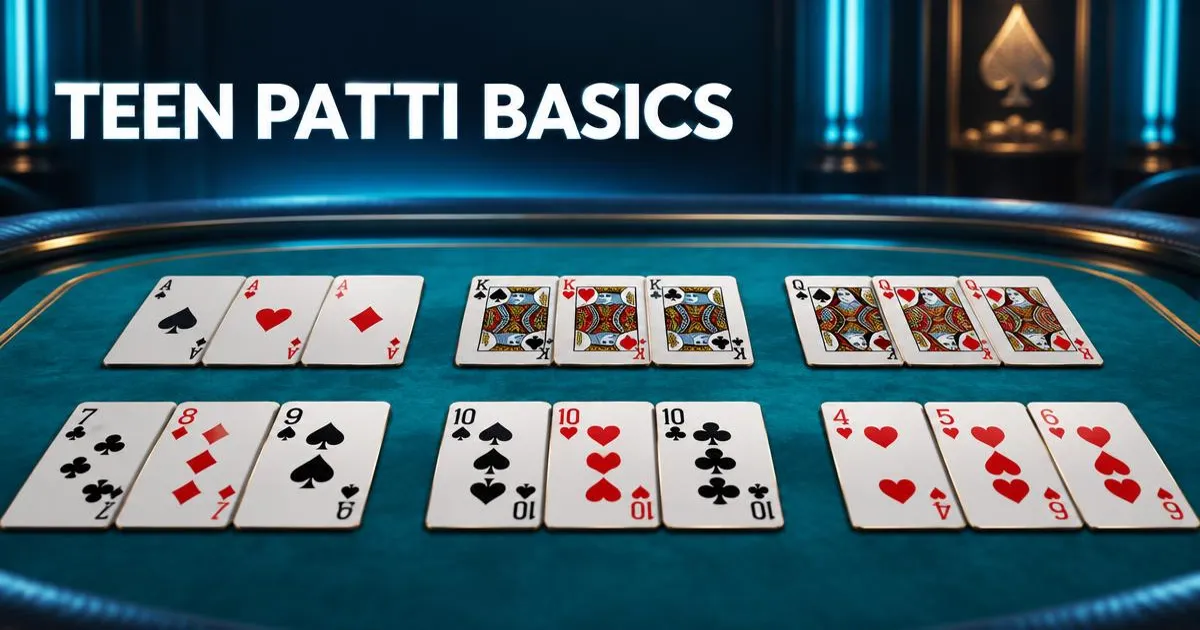
Teen Patti is a three-card game played with a standard 52-card deck. The basic idea is simple: each player gets three cards, and the best hand wins the pot.
This guide covers the traditional, widely documented rules and card rankings. It is meant for learning the game in general — not a description of any single app's exact settings.
The Basics: Deck, Deal and Boot
Teen Patti is traditionally played with one standard 52-card deck and no jokers in the classic version. Each player is dealt exactly three cards, face down.
Before the deal, every player contributes a small fixed amount called the boot to start the pot. This boot ensures there is always something to play for from the first round.
- Deck: 52 cards, no jokers (classic mode)
- Cards per hand: 3
- Boot: a small fixed stake paid by all players before cards are dealt
- Goal: have the best three-card hand, or make everyone else pack (fold)
Playing Blind vs Seen
After the boot, players decide whether to look at their cards or not. A player who has not looked at their cards is blind, and one who has looked is seen.
Blind players generally bet a smaller amount than seen players, since they are taking on more risk without knowing their hand. This difference is one of the core strategic elements of Teen Patti.
Why play blind?
Playing blind keeps bets lower and can make it harder for opponents to read your hand, since you have no information either. It is a traditional part of the game's rhythm, not a way to guarantee an outcome.
Betting, Chaal and Turn Order
Betting moves clockwise around the table. On each turn, a player can match the current stake to stay in (called chaal), raise it, or give up their hand (called pack or fold).
- The boot is collected from all players
- Each player in turn chooses blind or seen betting
- Players continue matching or raising the stake in turns
- A player can request a show when conditions allow, or players keep betting until only one remains
Show and Side Show
A show happens when only two players remain and one requests to compare hands to decide the winner. The better hand takes the pot.
A side show (sometimes called compromise) lets a seen player privately ask the previous seen player to compare hands, without revealing cards to the whole table. If the asking player's hand is lower, they pack; if equal or higher, the other player packs.
Side shows are a traditional rule but are not available at every stage of the game, and some tables or app modes disable them entirely.
Card Hand Rankings in Teen Patti
From strongest to weakest, here is the traditional Teen Patti hand ranking order used in classic play.
1. Trail / Set / Trio (Three of a Kind)
Three cards of the same rank, for example A♠ A♥ A♦. This is the strongest possible hand. Among two trails, the one with the higher rank wins.
2. Pure Sequence (Straight Flush)
Three consecutive cards of the same suit, for example 7♣ 8♣ 9♣. In most traditional rules, A-K-Q of the same suit is the highest pure sequence, and A-2-3 of the same suit ranks second highest.
3. Sequence / Run (Straight)
Three consecutive cards of mixed suits, for example 9♠ 10♥ J♦. It outranks a color hand but loses to any pure sequence.
4. Color (Flush)
Three cards of the same suit that are not in sequence, for example 2♥ 7♥ K♥. Compared by the highest card first, then the next, if two players both have a color.
5. Pair
Two cards of the same rank plus one unrelated card, for example 9♠ 9♦ 4♣. Higher pairs beat lower pairs; if pairs match, the side (kicker) card decides.
6. High Card
Three unrelated cards with no pair, sequence or matching suit, for example K♥ 8♠ 3♦. This is the weakest and most common hand, compared card by card from highest to lowest.
Seeing a Sequence in Practice
A quick way to recognise a sequence is to check if the three ranks run consecutively, such as 4-5-6 or J-Q-K, regardless of suit. Add matching suits and it becomes the much stronger pure sequence instead.
Understanding Color (Flush) Hands
A color hand only needs matching suits, not consecutive ranks. For example, 3♦ 9♦ Q♦ is a color because all three cards are diamonds, even though the ranks jump around.
When two players both hold a color, the comparison works like high card: compare the highest card in each hand, then the next highest, and so on.
How Ties Are Broken
Within the same hand category, rank decides the winner. A trail of kings beats a trail of nines. A pure sequence topped by an ace beats one topped by a nine.
- Trail: compare the three-of-a-kind rank
- Pure sequence / Sequence: compare the highest card in the run
- Color / High card: compare card by card from highest to lowest
- Pair: compare the pair rank first, then the side card
If every card matches exactly between two hands, the pot is typically split, though some tables use the suit order or dealer's position as a final tiebreaker. This varies and is not a universal standard.
Quick Ranking Summary
- 1. Trail / Set (three of a kind) — strongest
- 2. Pure Sequence (straight flush)
- 3. Sequence / Run (straight)
- 4. Color (flush)
- 5. Pair
- 6. High Card — weakest
Probability of Each Hand (Standard Deck Math)
These figures come from basic combinatorics on a standard 52-card deck dealt as three-card hands. They describe how rare each hand type is mathematically — they are not predictions or betting advice.
- Trail: 52 combinations out of 22,100 (about 0.24%)
- Pure Sequence: 48 combinations out of 22,100 (about 0.22%)
- Sequence: 720 combinations out of 22,100 (about 3.26%)
- Color: 1,096 combinations out of 22,100 (about 4.96%)
- Pair: 3,744 combinations out of 22,100 (about 16.94%)
- High Card: 16,440 combinations out of 22,100 (about 74.39%)
Common Rule Variations
Teen Patti has many regional and house variations layered on top of the classic rules described above. Common examples include adding jokers (wild cards), changing betting limits, or introducing special pot-splitting side games.
- Joker variations: one or more cards act as wild cards
- Muflis: lowest hand wins instead of highest
- AK47: specific cards are treated as wild
- Different maximum bet or pot limit structures
These variations change hand values significantly, so always confirm which variation is active before playing.
Rules in 3Patti Spin
3Patti Spin may offer several game modes, and each one can follow a different ruleset, betting structure or variation. The in-app rules screen for the specific mode you are playing is always the final word.
To see what modes are generally offered, check our 3Patti Spin games guide. For a step-by-step walkthrough of starting a hand on the app, see how to play 3Patti Spin.
Keep Learning the Terms
If words like chaal, pack or side show are still unfamiliar, our Teen Patti terms glossary explains each one in plain language with examples.
Once you're comfortable with the rules, visit the beginner guide to see how these concepts apply when you actually open the app.
Frequently Asked Questions
Get 3Patti Spin
Opens the game's download page in a new tab. Play responsibly, 18+.
Download 3Patti Spin